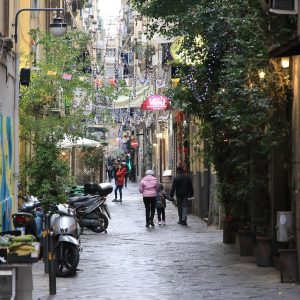
The choice of a bed and breakfast in the heart of Naples is not only about comfort, but also about the human experience: many of the downtown buildings are old monasteries or repurposed aristocratic homes, with wrought-iron balconies and inner courtyards where alleyways resonate with laughter and music. Our guests sleep in rooms with vaulted ceilings and terracotta floors and wake up to the smell of freshly baked sfogliatella. We offer breakfasts prepared with local products such as homemade jams, buffalo ricotta and pane cafone. We have a panoramic terrace from which to admire Mount Vesuvius and offer customized maps with thematic itineraries (art, street food, crafts) so you can experience Naples as an insider. Those who choose our B&B Naples historic center receives a familiar welcome and constant support in arranging itineraries and booking tours.
Staying in a B&B in the historic center of Naples is not just a convenient way to visit the city: it is a lifestyle choice. From our property just steps from Via dei Tribunali, every alley tells centuries of history and every corner smells of freshly baked pizza. As hosts, we receive travelers every day asking for advice on what to see or where to eat; these questions prompted us to develop a comprehensive guidebook. The goal is not to list checklist attractions, but to suggest authentic experiences to be lived at a Neapolitan pace. From Cathedral of San Gennaro to the views of the Vomero, via mouth-watering gastronomic stops, we will discover together ten must-do activities.
The historical center of Naples is a UNESCO World Heritage Site for its exceptional urban stratification and living traditions. Our location allows you to get around on foot or by subway, reaching museums, churches, catacombs and even the waterfront in minutes. During peak season we always recommend booking guided tours and purchasing tickets in advance, especially for popular sites such as Napoli Sotterranea and the Sansevero Chapel[1] Ready to discover the city like a true Neapolitan?
1. The Duomo and the Treasure of San Gennaro
Many visitors are unaware that beneath the cathedral is the Basilica of Saint Restituta, the oldest early Christian church in Naples. Dating from the 4th century, it preserves Byzantine mosaics and reused Roman columns-a journey through time even older than the cathedral itself. The apse section also contains the Baptistery of San Giovanni in Fonte, considered the oldest baptistery in the West, with frescoes depicting Christ among the saints and geometric motifs of rare beauty. Another treat is the Succorps Chapel, Renaissance crypt designed by Francesco Grimaldi, where the remains of St. Gennaro rest. To access it, one must walk down hidden stairs that lead to a room decorated with polychrome marble and bas-reliefs. These treasures are often overlooked by guidebooks, but thanks to our network of contacts with the cathedral's custodians, we can arrange private tours outside opening hours. History lovers will be fascinated by the interweaving of eras and styles.
One cannot begin an itinerary in Naples without paying homage to its patron saint. The Cathedral of San Gennaro, or Cathedral of Santa Maria Assunta, stands in the heart of the city and houses the world-famous Treasury. The architectural complex combines Gothic, Renaissance and Baroque styles; entering from the 14th-century facade leads to the nave adorned with polychrome marble, mosaics and paintings. The Chapel of the Treasury, dating from the 17th century, houses the relics of the martyr St. Gennaro, including ampoules of his blood, which according to tradition liquefy three times a year. The miracle is followed with trepidation by the faithful and is an identity symbol for the city[2]
In addition to the chapel, the Treasury includes a collection of reliquary busts and precious votive offerings donated over the centuries by popes, kings and citizens. The gilded silverware, embroidered vestments, and gems testify to the deep devotion of the Neapolitan people[2] To fully understand this heritage, we recommend participating in a guided tour, which also includes the museum section adjacent to the cathedral. The tour will allow you to discover the history of the saint and the story of the eruptions of Vesuvius, plagues and miracles that marked the life of the city.
After the visit, we suggest taking a walk along Cathedral Street to Nicola Amore Square, where numerous stores and cafes offer refreshments. Returning to our B&B Naples historic center, don't forget to ask us hosts for recommendations on special events: during the weeks of the miracle, for example, the atmosphere around the cathedral becomes even more atmospheric with markets, concerts and screenings.
2. Naples Underground: discovering the hidden soul
The underground experience does not end at the official route. A few meters from the cathedral another network of tunnels starts: the Decumanus Submerged, a section that can be visited only with flashlights, where you can feel the freshness of the water and hear tales of superstition. For the past few years, the cisterns of the Carmignano, a series of 17th-century tanks that fed the aqueduct built by the nobleman Cesare Carmignano in the 17th century. The Association that runs Napoli Sotterranea organizes educational workshops for children and theatricalized tours in which costumed actors tell stories of Greeks, Romans and Bourbons. The underground of Naples is so vast that some tunnels reach as far as Posillipo; it is even said that the legendary “Grotta di Cocceio” connected Pozzuoli to the Phlegrean area. Those who wish to complete the itinerary can also visit the Bourbon Gallery on Domenico Morelli Street, where vintage cars, motorcycles and statues abandoned during the war are preserved.
Beneath the bustle of the streets, Naples hides another world. [Naples Underground]([3]) offers a fascinating tour 40 meters down, where Greek quarries, Roman aqueducts, medieval cisterns and air raid shelters alternate. The official website mentions that the visit allows visitors to retrace 2,400 years of history[4] Walking through the tunnels dug into the tuff, it is easy to imagine the engineering of the ancient Greek and Roman geologists, who made possible the water supply to the city[4] During World War II, these same tunnels became shelters for hundreds of families, as graffiti and preserved objects still testify[4]
The visit is divided into several sections: from the Bourbon Gallery, built in the 19th century to connect the Royal Palazzo to Piazza Vittoria, to the underground gardens where plants grow in the dark. The association's speleologists explain the function of the shafts and show the ancient Greek-Roman Theater, which remained hidden for centuries under the houses of San Lorenzo Maggiore. The tour is not suitable for those suffering from claustrophobia, but it is a must-see experience for those who want to understand how the city exploited the underground[1]
We recommend booking your visit online, especially during busy periods. Our B&B in the historic center is less than a ten-minute walk from the entrance to San Gaetano Square; we often accompany our guests to the small square and wait for them at the end of the tour to hear their impressions. The hike takes about 90 minutes; bring a light sweatshirt because the temperature underground is cool even in summer.
3. San Gregorio Armeno: the street of nativity scenes.
The church of San Gregorio Armeno, which gives its name to the street, is worth a visit for its lavish Baroque decoration: the interior houses works by Luca Giordano and a polychrome marble altar. From the choir, it is possible to overlook the monastery cloister, where cloistered nuns cultivate a citrus grove and sing during Mass. The nativity tradition is rich in symbols: the sleeping shepherd Benino represents the anticipation of Christmas, while the washerwoman symbolizes purification. Workshops work with techniques that have been handed down for generations: cork is hand-cut, figurines are baked in terracotta ovens and painted with natural pigments. In the fall, artisans participate in the “Nativity Scenes on Display” event, which allows visitors to purchase unique pieces and hear stories about the nativity characters. This direct support for artisans helps preserve a craft threatened by industrial production.
A few steps from the cathedral, in the maze of alleyways of the old town, winds San Gregorio Armeno, the famous “street of nativity scenes.” This street, which connects the main decumanus with the lower decumanus, is world famous for the workshops that make terracotta figures for the Neapolitan nativity scene. The origins of this tradition are rooted in history: Roman houses in the neighborhood housed a temple dedicated to Ceres, goddess of fertility, as early as the second century B.C., and terracotta votive offerings may have inspired the custom[5] In the Middle Ages, the monastery of San Gregorio Armeno was built, and in the eighteenth century the friars began to cede store spaces to artisans who modeled shepherds and animals[6]
Today, strolling along the street, one can admire an explosion of creativity: figurines depicting current personalities, politicians or celebrities appear alongside traditional shepherds, demonstrating the vitality of Neapolitan satire. Master nativity scenesters work year-round to make painted terracotta figurines and cork scenery; many workshops open their doors to visitors showing centuries-old techniques. From November to January the street comes alive with visitors, but our advice is to visit in spring or summer, when it is easier to watch the artisans at work[5]
A curiosity to tell the guests of the B&B: The Neapolitan nativity traditionally is not limited to the Nativity scene, but tells the story of the daily life of the people. Amidst fish fryers, fishmongers, washerwomen and taverns, you will catch scenes rooted in eighteenth- and nineteenth-century Naples. By taking home a handmade figurine you will help sustain a tradition that is in danger of disappearing without conscious tourism.
4. Sansevero Chapel and the Veiled Christ
Beyond the Veiled Christ, the chapel holds other wonders. The floor features an intricate marble labyrinth symbolizing the initiate's path to knowledge; according to some interpretations, following the design with the eye would have esoteric significance. The walls are covered with frescoes by Francesco Maria Russo depicting allegories of the Virtues, while statues celebrate the moral qualities of members of the di Sangro family. Prince Raimondo was an eclectic character: he was a scientist, inventor, Freemason, and patron; he is credited with experiments on gunpowder, color printing, and even the invention of a waterproof fabric. His figure inspired novels and television series. Inside the sacristy of the chapel is a library with manuscripts and drawings; unfortunately, it is not open to the public, but special tours are organized during FAI Spring Days. After visiting the chapel, it is worth stopping in the nearby Piazzetta Nilo to admire the statue of the Nile, vestiges of the ancient Egyptian cult present in the city.
Tucked away in an alley between Via dei Tribunali and Piazza San Domenico Maggiore stands the wonderful [Sansevero Chapel]([7]), a treasure chest of Neapolitan Baroque. Built in 1590 by the Duke of Torremaggiore and transformed in the 18th century by Prince Raimondo di Sangro, the chapel houses works of art of astonishing realism and symbolism. The best-known masterpiece is the Veiled Christ by Giuseppe Sanmartino (1753): the marble seems to become fabric, so much so that visitors still wonder about the technique used[8] Alongside, Antonio Corradini's statues of Modesty and Francesco Queirolo's Disenchantment tell allegories of virtue and liberation[9]
The chapel is steeped in myths and legends: some believe that Raimondo di Sangro, a scientist and alchemist, had discovered a method to “marmerize” the veil; others are fascinated by the anatomical machines, two skeletons that mimic the human circulatory system and for centuries fueled stories of forbidden experiments[9] In fact, recent studies have shown that these are patterns made from wire and wax, but their effect remains impressive[8]
A visit to the Sansevero Chapel requires reservations and takes about 30 minutes. From our B&B we like to recommend scheduling the tour in the early morning hours to avoid the crowds; after leaving you can stop at the nearby “Scaturchio” café to enjoy a baba or sfogliatella, typical Neapolitan pastries. Remember to look up when you are inside the chapel: the frescoed vault represents divine action infusing science into the arts and is truly breathtaking.
5. Spaccanapoli: the beating heart of the city.
Spaccanapoli's charm also lies in the folk traditions celebrated here. Every year in February, the church of San Biagio dei Librai celebrates its patron saint with the blessing of the throat: the faithful carry candles that are crossed over their necks for protection. In July, the Feast of the Carmine sees thousands of people parading with lit candles, while in September the procession of San Gennaro passes through the streets carrying the statue of the saint. Stores on Via San Biagio dei Librai still feature printers working with hand presses, while classical music concerts are held in some noble houses. Osterias serve traditional dishes such as genovese (meat and onion sauce), tripe and soffritto; vinerias offer Falanghina, Greco di Tufo and Aglianico. In the evening, Spaccanapoli is transformed: young college students gather in the little bars to drink craft beer and listen to up-and-coming bands. Walking here at night is safe and offers the opportunity to see illuminated buildings and murals dedicated to Totò and Maradona.
Spaccanapoli is not the official name of a street, but the nickname given to the lower decumanus because it cuts through the historic center in a straight line, like a rift visible from above[10] Starting from Via Benedetto Croce and continuing along Via San Biagio dei Librai and Via Vicaria Vecchia, it traverses centuries of history: gothic churches, aristocratic palaces, street food stalls and artisan stores coexist within a few meters[11] To walk along this path is to immerse oneself in the soul of the city, to listen to the chanting dialect and to breathe in the smell of ragu on Sunday mornings.
Among the stops not to be missed are the Church of the New Jesus, with its ashlar facade and rich interior; the Church of St. Clare, with the tiled cloister; and the Palazzo Venice, a small hidden gem with an inner garden. Further on you will encounter the Piazza del Purgatorio in Arco with its Baroque church of the same name. The pastry shops along the street offer freshly baked sfogliatelle ricce and frolle; the friggitorie sell cuoppi di fritto misto (zeppoline, panzarotti, vegetables) to enjoy while walking[11]
For those staying in our B&B Naples historic center, the walk in Spaccanapoli is a daily ritual. We suggest walking it twice: once in the morning, when the churches are open and the tolling of bells mark time; the other in the evening, to experience the movida among bars, taverns and live music. Don't forget to push into the side alleys: that's where the workshops of goldsmiths and tailors, repositories of ancient crafts, are hidden.
6. Plebiscite Square and Palazzo Royal
La Basilica of St. Francis of Paola, overlooking Piazza del Plebiscito, is a tribute to the Roman Pantheon. It was built in the 19th century at the behest of Ferdinand I after the Bourbon restoration; the circular interior is topped by a dome more than 50 meters in diameter and contains statues of saints and side altars dedicated to the Madonna and St. Joseph. In front of the palace stand equestrian statues of Ferdinand I and his son Francis I, sculpted by Antonio Canova and his pupil Antonio Calì[12] The square is pedestrian friendly and often hosts art installations: during the Christmas season, for example, illuminations and modern nativity scenes are placed. To the side of the square is the famous San Carlo Theater, one of the oldest opera houses in Europe. Thanks to an internal passageway of the Royal Palazzo, the court could attend performances without going outside. Guided tours take you behind the scenes of the theater, through gold-decorated boxes and the magnificent foyer.
A complete itinerary also includes a visit to the Roof Garden Of the Palazzo, overlooking the sea, and at the Gambrinus coffee, historic haunt of intellectuals where the custom of suspended coffee was born. Sit among the Art Nouveau mirrors and order an espresso with cream: a retro experience that will take you back in time. For shopaholics, Via Chiaia and Via Toledo offer fashion boutiques, independent bookstores and artisan workshops; a few meters from the square is also the historic Bourbon Gallery With its underground routes.
After exploring the alleys of downtown, it is time to widen the horizon to the waterfront. Plebiscite Square Is the largest square in Naples, with more than 25,000 square meters of area[13] Designed by Domenico Fontana in the late 16th century to celebrate the arrival of King Philip III, the square assumed its current name in honor of the 1860 plebiscite that sanctioned the annexation of the Kingdom of the Two Sicilies to the Kingdom of Italy[14] Overlooking the square are the Basilica of St. Francis of Paola with its neoclassical colonnade and the Palazzo Royal Naples, residence of the Spanish viceroys and later the Bourbons.
The [Palazzo Real]([15]) was begun in 1600 as a residence to welcome the visiting king of Spain and later expanded by the Bourbon rulers; the façade, nearly 170 meters long, is one of the masterpieces of the late Renaissance[12] Inside is the Scalone d'Onore (Staircase of Honor), a majestic marble staircase leading to the royal apartments decorated with stucco, frescoes and 18th-19th century furnishings. Today the palace houses a museum that tells the story of the dynasty and the city; you can visit the Throne Room, the Great Captain's Room and even the loggia overlooking Vesuvius.
The square is also a meeting place for Neapolitans: concerts, events, Christmas markets and even impromptu soccer games are held here. From our B&B you can reach it in twenty minutes on foot, passing through Via Toledo with its boutiques and the Galleria Umberto I with its elegant iron and glass architecture. We suggest you admire the sunset sitting on the steps of the basilica, perhaps enjoying a lemon granita, and return in the evening when the square lights up creating a romantic atmosphere.
7. Castel dell'Ovo: the legend on the water.
The history of Castel dell'Ovo is intertwined with that of Naples: from its origins as the villa of the patrician Lucullus to the Byzantine period, when it became a monastery dedicated to Saints Salvator and Severinus. In the Middle Ages it was a stronghold of the Normans and later of the Swabians and Angevins; Joan I of Anjou moved her court there to escape epidemics. With the Aragonese, the castle was enlarged and equipped with towers and bastions; it became a prison for illustrious personages, including the poet Tommaso Campanella. After the Unification of Italy, it lost its military function and was turned into Navy offices. Today, in addition to exhibitions, it hosts cultural events such as the festival of the Orient and jazz concerts at sunset. From the castle bastion starts the scenic walk to Via Partenope, where Belle Époque palaces house luxury hotels and historic cafes. During the summer, the city administration closes the waterfront to traffic for the “Lungomare Liberato” event: citizens and tourists invade the street by walking, biking or doing outdoor yoga.
On the rocky outcrop of the island of Megaride, connected to the mainland by a bridge, stands the Castel dell'Ovo. It is the oldest castle in Naples: built by the Normans in the 12th century on a Roman villa, it was later expanded and used as a fortress, royal residence, monastery, and prison[16] According to a famous legend, its name comes from an egg that the poet Virgil allegedly hid in its foundations: as long as the egg remains intact, the city will also prosper. This story is recalled on the official website of the municipality, which points out that the egg's integrity was considered to be linked to the fate of the castle[17]
Today the castle is a must-see for its breathtaking views of the gulf and the charm of its walls. Climbing the terraces you can admire Vesuvius, Capri, the Sorrento coastline and the outline of Posillipo. Art exhibitions and concerts are held inside; admission is free and allows you to explore the halls of the ancient arsenal, towers and courtyard. At the foot of the castle is the Borgo Marinari, a small marina where boats and yachts swing in the clear water and where excellent seafood restaurants and drinking establishments are concentrated[16]
From our B&B Naples historic center you can reach Castel dell'Ovo with a half-hour walk along Via Partenope, skirting the Lungomare Caracciolo. We suggest visiting it in the morning to enjoy the grazing light on the walls and to stop at one of the small restaurants in the village for a lunch of spaghetti alle vongole or mussel soup. In summer, the nearby Rotonda Diaz beach is ideal for a refreshing dip, while in winter the waterfront becomes a romantic place for hand-in-hand walks.
8. National Archaeological Museum of Naples (MANN)
In addition to the permanent collections, MANN offers a rich calendar of temporary exhibitions ranging from contemporary art to numismatics. The Sundial Hall, an octagonal hall with a black and white marble floor, often hosts multimedia installations. The Prehistoric Section displays flint tools from the Castelcivita site, showing that the Campania region was inhabited as early as the Paleolithic period. The Epigraphic Section features Latin and Greek inscriptions engraved on stone, ceramics, and metal, while the Gladiator Gallery collects armor, helmets and reliefs that tell the story of the life of fighters in the arena. Thanks to European projects, the museum has digitized numerous artifacts and offers interactive apps that allow visitors to see 3-D reconstructions of ancient buildings. The MANN also collaborates with international universities on archaeological studies and organizes lectures, workshops for children and jazz concerts in the inner courtyard. With the annual card, residents have unlimited access and discounts at other museums in Campania.
Those who love art and archaeology cannot miss the [National Archaeological Museum of Naples]([18]). Established in the 18th century at the behest of Charles of Bourbon, the museum brings together the collections of the Farnese family and artifacts from excavations in Herculaneum, Pompeii, and Campania felix[19] His son Ferdinand IV unified the collections into a single complex, creating the Royal Bourbon Museum. The building, which had formerly been cavalry barracks and the seat of the University, now houses one of the most important collections of classical art in the world[19]
Among the most striking rooms we highlight that of the Farnese Collection, with monumental sculptures such as the Farnese Bull and the Farnese Hercules; the Egyptian Section, which houses sarcophagi, mummies and papyri; and the Secret Cabinet, where frescoes and erotic objects from Pompeii are displayed. One entire floor is devoted to mosaics and frescoes from Pompeian villas; another houses the numismatic collection and the famous Farnese Atlas. Temporary exhibits complete a tour that takes at least three hours to fully appreciate. The museum also offers educational workshops for children and guided tours with archaeologists.
Our B&B is a ten-minute walk from the MANN: just take Via Duomo towards Piazza Cavour. After your visit, we recommend taking a break in the public garden in front (Museum Square) or sipping coffee in the nearby historic cafes. If you have time, you can combine the visit to the museum with the station Museum of the Metro Line 1, displaying archaeological artifacts and contemporary art installations.
9. Catacombs of San Gennaro: a journey through time.
Le Catacombs of San Gennaro are part of a larger system of underground burials that includes the catacombs of San Gaudioso and the Fontanelle Cemetery. The latter, located inside a tufa quarry, houses thousands of skulls and bones lined up on shelves: the place is linked to the worship of the beggar souls, souls in pain to whom the faithful entrust wishes in exchange for prayers. The catacombs are also a virtuous example of urban regeneration: the association “La Paranza” has created jobs for young people in the neighborhood and reinvested tourist revenues in social projects. After visiting, many tourists stop at the nearby Palazzo of Spanish, a splendid Baroque residence with monumental double-winged staircase, and taste the famous “snowflake” cake from Pasticceria Poppella. The Sanità neighborhood is experiencing a cultural renaissance thanks to theatrical activities, murals and music festivals. To go beyond stereotypes is to understand the human richness of this area.
In the Sanità district, a few kilometers from downtown, a dense underground labyrinth extends: the Catacombs of San Gennaro. According to archaeologists, the original nucleus dates back to the 2nd-3rd centuries CE and originated as the burial place of a patrician family[20] The area expanded when the body of St. Agrippinus, the first patron saint of Naples, was transferred there, and especially when the remains of St. Gennaro were laid to rest in the 5th century: the martyr's presence made the catacomb a place of worship and pilgrimage[21] Over the centuries, two levels were excavated over an area of more than 6,000 square meters, with extensive galleries, frescoed chapels and an underground basilica still used for religious services.
The upper part holds frescoes from the 3rd-4th centuries that represent some of the oldest Christian paintings in southern Italy[20] Descending into the lower catacomb we pass through monumental rooms such as the Crypta of the Episcopes, where the first bishops of Naples are buried, and discover a baptistery built in the 8th century. The visit includes guidance from operators of the cooperative “La Paranza,” composed of young people from the neighborhood whose activities have contributed to the rebirth of Sanità.
To reach the catacombs from our B&B, you can take subway line 3 “Salvator Rosa” or walk down Via Foria and up toward Capodimonte. Near the catacombs is the Basilica of Santa Maria della Sanità, with its iconostasis and cloister designed by Fra Nuvolo. We suggest combining a visit to the catacombs of San Gaudioso, also run by the cooperative, where frescoes and skulls decorate the niches in surprising ways. It is an opportunity to understand the ancient relationship of Neapolitans with death and the memory of the dead.
10. Castel Sant'Elmo, Vomero panorama and local flavors.
The Castel Sant'Elmo is not just a belvedere: walking along the ramparts, one encounters cannons, loopholes, and heraldic crests that tell the story of the evolution of fortification art. Its six-pointed star shape, designed to withstand artillery strikes, can be particularly appreciated from above with a drone or from the aerial photos displayed at the entrance. Inside the castle are museum spaces dedicated to contemporary art and an auditorium where screenings and theater performances are held. Each year it hosts the festival “Summer at St. Martin's” with concerts and outdoor cinema. Also departing from the castle is the Pedamentin, a striking staircase of 414 steps that descends to Montesanto: walking down it is a poetic way to get to the center while crossing terraced vegetable gardens and unexpected views.
The Vomero district, where the castle is located, offers different dining experiences than downtown: here you will find gourmet pizzerias, artisanal ice cream parlors, wine bars, and breweries from microbreweries in Campania. At the Antignano market you can sample fresh produce such as buffalo mozzarella, pane cafone and sweet taralli. In the evening, Via Aniello Falcone comes alive with trendy bars serving aperitifs with views of the city. We recommend stopping at a Vomero trattoria to try the Neapolitan ragout cooked slowly for hours, or the casatiello, flatbread stuffed with salami and cheese typical of the Easter holidays.
Naples is also home to coffee: Neapolitans drink it ristretto, hot and sweetened. The tradition of cuccumella, the copper coffee pot used before the invention of the mocha, still survives in some households. Historical coffee shops also serve the hazelnut coffee, coffee and hazelnut cream, and the sambuca coffee With a small glass of anise liqueur. The custom of the suspended coffee - pay a coffee to those who will come after-it is a gesture of solidarity that reflects the generous hearts of Neapolitans. In addition to coffee, we suggest you try the limoncello of Sorrento and handcrafted licorice or fennel liqueurs.
Dominating the city from the top of the Vomero hill is the Castel Sant'Elmo, a star-shaped fortress built in the 16th century on an earlier Norman tower. Commissioned by Viceroy Don Pedro de Toledo and designed by Spanish architect Pedro Luis Escrivá, the fortress played a key role in the city's defense and was the scene of sieges and revolts[22] After serving as a military prison, it now houses the Museum of the Twentieth Century and numerous temporary exhibitions. The parade ground offers a 360-degree panorama of the gulf, Vesuvius, the hinterland, and the islands-a sight that leaves one speechless.[23]
To reach the castle from our B&B Naples historic center, you can take the funicular from Montesanto to the “Morghen” station and then follow the signs. Next to Castel Sant'Elmo is the Charterhouse of San Martino, a Baroque masterpiece with a panoramic cloister and the Museum of Sacred Art. After admiring the artworks and gardens, treat yourself to a coffee on the terrace. The Vomero district also offers shopping streets such as Via Scarlatti and Via Luca Giordano, flea markets and public parks such as the Villa Floridiana.
A visit to Naples is not complete without immersing oneself in its flavors. Pizza is the undisputed queen: the [Pizzeria Da Michele]([24]), founded in 1870 by Michele Condurro, offers only two variants (Margherita and Marinara) and keeps the recipe intact with long-rising dough, fiordilatte di Agerola and San Marzano tomatoes[25] The Condurro family has championed simplicity and quality ingredients for more than five generations[26] so much so that it was even celebrated in the movie *Eat, Pray, Love*. Booking is not possible: you take the number and wait on the street, a ritual that is part of the experience.
The Neapolitan pizza culture has been recognized by UNESCO as an intangible heritage of humanity. The ’Art of the Neapolitan pizzaiuolo“ comprises four stages-preparation of the dough, forming, stuffing and baking-and brings together some 3,000 pizza makers who pass on the techniques from father to son[27] For our guests, we also recommend other historic pizzerias such as. Sorbillo, By Matthew e Starita, each with its own interpretation.
In addition to pizza, Naples boasts a very rich pastry. La sfogliatella is the queen: the “curly” version with crisp layers was born in the 17th century in the convent of Santa Rosa on the Amalfi coast[28] while the softer “shortbread” was invented in 1818 by Pasquale Pintauro in Naples[29] Also noteworthy are the pastiera, rum baba, and “suspended coffee,” a tradition whereby you pay for extra coffee to be donated to those who cannot afford it. We suggest our guests try these desserts in historic pastry shops such as Scaturchio o Carraturo.
To end the day, head to our communal kitchen for an aperitif with products purchased during your explorations: smoked provola cheese, Neapolitan salami, taralli ‘nzogna e pepe, and a glass of Campi Flegrei wine. You will share your impressions with other guests and perhaps find yourself singing a classical song accompanied by a guitar.
For those staying more days, we recommend exploring less touristy neighborhoods such as Posillipo, with the Pausilypon Archaeological Park and Seiano Cave, or the Phlegrean area with the sites of Cuma and Pozzuoli. An excursion to Procida o Ischia completes your knowledge of the gulf with seascapes and colorful villages. Naples never ceases to amaze: each visit reveals a detail, a hidden church, a different flavor. Our B&B Naples historic center will always be ready to welcome you and recommend new itineraries. By experiencing the city slowly, letting your curiosity guide you, you will feel part of an ancient and vibrant community, and you will carry with you the echo of its songs and the intensity of its smells.
Naples is a city of many shades, where the sacred and the profane coexist and where every corner tells a story. Choosing a B&B in the historic center means immersing yourself in the urban fabric, getting to know your neighbors, savoring coffee at the counter, and getting lost in the markets. In this article we have described ten experiences that represent the essence of the city: from the Duomo to the underground, from nativity scenes to pizza, from museums to views. Each place mentioned is easily accessible from our B&B Naples historic center and all offer insights into Neapolitan culture and traditions.
Before you leave, remember that the beauty of Naples lies not only in the monuments, but mostly in the people. Talk to the fishermen at the pier, be guided by the artisans of San Gregorio Armeno, listen to the tales of the guardians of the museum and catacombs. Returning to our B&B, you will always find someone to share a smile and a glass of limoncello with. And when you look back on your stay, you will find that Naples has given you much more than a list of things to see: it has offered you a way of life, one to take with you always.
Sources
- https://www.travel365.it/napoli-cosa-vedere.htm#:~:text=2%20.
- https://www.travel365.it/napoli-cosa-vedere.htm#:~:text=1%20,di%20San%20Gennaro.
- https://www.napolisotterranea.org
- https://www.napolisotterranea.org/#:~:text=Napoli%20Sotterranea%3A%20Uno%20stupefacente%20viaggio,visite%20guidate%20nella%20Napoli%20Sotterranea.
- https://www.levocidinapoli.it/san-gregorio-armeno-la-via-dei-presepi/#:~:text=Metro%3A%20linea%201%20stazione%20Dante,stazione%20Universit%C3%A0.
- https://www.levocidinapoli.it/san-gregorio-armeno-la-via-dei-presepi/#:~:text=Nel%20corso%20del%20XV%20secolo%2C,un%20gruppo%20di%20monache%20basiliane.
- https://www.museosansevero.it
- https://museinapoli.it/cappella-san-severo-e-cristo-velato/#:~:text=Cappella%20San%20Severo%20e%20Cristo,Velato.
- https://museinapoli.it/cappella-san-severo-e-cristo-velato/#:~:text=La%20scultura%20del%20Cristo%20velato,modo%20perfetto%20e%20molto%20realistico.
- https://www.paesionline.it/italia/vie-piazze-e-quartieri-napoli/spaccanapoli#:~:text=Spaccanapoli%2C%20la%20strada%20che%20taglia,in%20due%20la%20citt%C3%A0.
- https://www.paesionline.it/italia/vie-piazze-e-quartieri-napoli/spaccanapoli#:~:text=Spaccanapoli%20costituisce%20il%20decumano%20inferiore,Benedetto%20Croce%20e%20via%20Forcella.
- https://cultura.gov.it/luogo/palazzo-reale-di-napoli-1#:~:text=Il%20Palazzo%20Reale%20di%20Napoli,spiazzo%20del%20Largo%20di%20Palazzo.
- https://www.visitnaples.eu/napoletanita/scopri-napoli/piazza-del-plebiscito-storia-e-bellezze-di-una-piazza-storica-di-napoli#:~:text=Piazza%20del%20Plebiscito%3A%20uno%20dei,luoghi%20simbolo%20di%20Napoli.
- https://www.visitnaples.eu/napoletanita/scopri-napoli/piazza-del-plebiscito-storia-e-bellezze-di-una-piazza-storica-di-napoli#:~:text=All%E2%80%99estremit%C3%A0%20di%20piazza%20del%20Plebiscito%2C,primo%20nucleo%20abitativo%20dell%E2%80%99antica%20Partenope.
- https://palazzorealedinapoli.org
- https://www.campania.info/napoli/cosa-vedere-napoli/castel-dell-ovo/#:~:text=Castel%20dell%E2%80%99Ovo.
- https://www.comune.napoli.it/casteldellovo#:~:text=Sull%27antico%20Isolotto%20di%20Megaride%20sorge,la%20fortuna%20dil%20Castel%20Marino.
- https://www.museoarcheologiconapoli.it
- https://www.museoarcheologiconapoli.it/storia-del-museo/#:~:text=Il%20Museo%20Archeologico%20Nazionale%20di,offerto%20al%20panorama%20culturale%20europeo.
- https://museinapoli.it/catacombe-san-gennaro/#:~:text=Le%20catacombe%20di%20San%20Gennaro,della%20fede%20cristiana%20a%20Napoli.
- https://museinapoli.it/catacombe-san-gennaro/#:~:text=Le%20caratterische%20principali%20delle%20catacombe.
- https://enjoy.vivi.city/idee-di-viaggio/castel-sant-elmo-la-fortezza-di-napoli.html#:~:text=Castel%20Sant%27Elmo%2C%20con%20la%20sua,citt%C3%A0%20in%20tutte%20le%20direzioni.
- https://enjoy.vivi.city/idee-di-viaggio/castel-sant-elmo-la-fortezza-di-napoli.html#:~:text=Castel%20Sant%27Elmo%2C%20con%20la%20sua,citt%C3%A0%20in%20tutte%20le%20direzioni
- https://www.damichele.net
- https://www.damichele.net/storia-e-passione/#:~:text=L%E2%80%99Antica%20Pizzeria%20da%20Michele%2C%20per,ai%20volti%20di%20tante%20celebrit%C3%A0.
- https://www.damichele.net/storia-e-passione/#:~:text=Nel%201870%20la%20famiglia%20Condurro,cuore%20del%20centro%20di%20Napoli,
- https://ich.unesco.org/en/RL/art-of-neapolitan-pizzaiuolo-00722#:~:text=The%20art%20of%20the%20Neapolitan,and%20elements%20of%20the%20craft.
- https://grancaffegambrinus.com/la-storia-e-lorigine-della-sfogliatella/#:~:text=Siamo%20tra%20Furore%20e%20Conca,sempre%20molto%20simili%20tra%20loro,
- https://grancaffegambrinus.com/la-storia-e-lorigine-della-sfogliatella/#:~:text=Decise%2C%20cos%C3%AC%2C%20di%20rivisitarne%20la,e%20divenendo%2C%20egli%20stesso%2C%20pasticciere.