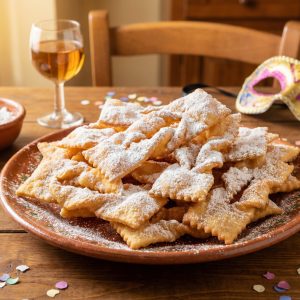
Le chatter are one of the oldest traditional Italian sweets. Their history has its roots as far back as the’Ancient Rome, long before Naples became a major center of European pastry making.
During the Roman era, on the occasion of the Saturnalia - folk festivals dedicated to the god Saturn - fried desserts called frictilia: strips of flour and egg dough, fried in lard and distributed to the people. These sweets are considered the direct ancestors of modern chatter.
From the Middle Ages to the Kingdom of Naples
With the fall of the Roman Empire, the tradition of fried desserts did not disappear. On the contrary, it went through the Middle Ages adapting to local availability and religious calendars. In Kingdom of Naples, the preparation of the chatter became inextricably linked to the Carnival, the period before Lent, during which rich, caloric foods were allowed to be consumed before religious restrictions. Naples, a city of court and people, turned this simple dessert into a collective symbol: easy to prepare, cheap and suitable for sharing.
Why are they called chatter?
The name chatter originated in Naples and Campania. According to popular tradition, the term recalls the climate of celebration, lightness and conversation typical of Carnival:
you eat chatter While making... chatter. It is an evocative, ironic name, perfectly in line with the Neapolitan spirit, which likes to attribute social and symbolic as well as gastronomic meanings to foods.
One dessert, a thousand names (but one soul)
In Italy the same cake takes on different names depending on the region:
- chatter - Campania
- frappe - Latium
- lies - Piedmont and Liguria
- crostoli o galani - Veneto
- lettuces - Lombardy
Despite the different names, the basic recipe remains surprisingly similar, a sign of a common tradition across the peninsula.
Le chatter in the Neapolitan tradition
In Naples the chatter are not just a dessert, but a seasonal rite. They appear in bakeries between January and February and officially mark the beginning of Carnival. They are often accompanied by the black pudding, a spiced chocolate cream that used to contain pig's blood, now replaced by cocoa and spices for health reasons. The act of dipping a chat at black pudding is one of the most recognizable gastronomic symbols of the Neapolitan Carnival.
Curiosities about the chatter
- They are one of the oldest Italian sweets still on the market
- Born as a dessert “of the people,” not aristocratic
- They must be very thin: excessive thickness is considered a mistake
- Traditionally they are fried, but there are baked versions
- Every Neapolitan family has its own “secret recipe”
Because the chatter stand the test of time
The strength of the chatter lies in their simplicity: few ingredients, precise technique, and deep cultural meaning. They do not follow fads or prolonged commercial seasons. They arrive, last the time of Carnival and then disappear. And it is precisely this waiting that makes them special every year. In Naples, eating chatter is not just a gastronomic treat: it is a way to reconnect with the city's history, tradition, and identity.